MOBEP: Opinion-Behavior Co-evolution Framework
A unifying framework for building and comparing models of opinion polarization
Opinions and behaviors evolve together. People act partly on what they believe, observe what others do, infer the opinions behind those actions, and adjust their own views. Yet these feedbacks have often been modeled in isolation, making it difficult to compare models or accumulate their insights.
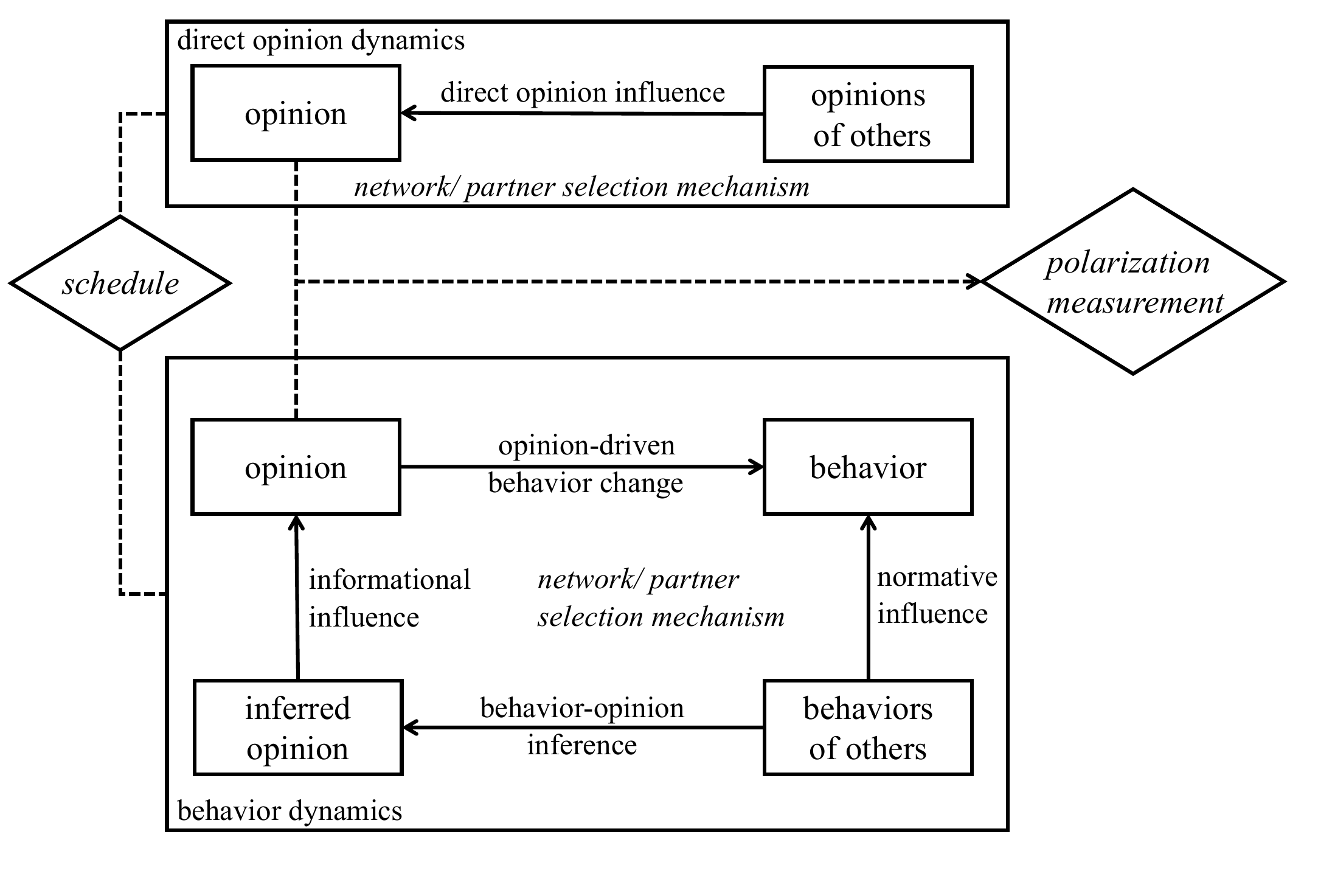
MOBEP (Modeling Opinion-Behavior Co-evolution for Explaining Opinion Polarization) provides a shared architecture for studying these processes. The framework connects opinion change, behavior change, social inference, network structure, scheduling, and polarization measurement in one modeling language.
How the framework works
MOBEP distinguishes two complementary routes of social influence:
- Direct opinion dynamics: people communicate opinions, allowing others’ opinions to influence their own directly.
- Behavior dynamics: opinions shape behavior; people observe others’ behavior, infer the opinions behind it, and update their own opinions. Normative influence can also make observed behavior affect one’s behavior directly.
These processes are embedded in a network or partner-selection mechanism and connected to two practical modeling choices: the schedule governing when events occur and the measurement used to assess polarization.
Why MOBEP matters
MOBEP serves both as an organizing framework and a model-building template. Researchers can use it to:
- reveal which mechanisms an existing model includes or omits;
- compare models expressed in otherwise incompatible terminology;
- design new opinion-behavior models systematically; and
- connect micro-level mechanisms to macro-level polarization measurements.
The chapter demonstrates these uses by mapping several established models onto MOBEP and by constructing a case study of mask-wearing behavior during the COVID-19 pandemic.
Credits
- Tanzhe Tang
- Amineh Ghorbani
- Caspar Chorus
More information
- Read the standalone MOBEP thesis chapter.
- View the complete doctoral dissertation.